


- 15/6/12
- 1,825
- 4,354
- Banned
- #1
Mình thấy tin về VGA post ở đây cũng được, miễn là liên quan đến game nên cái này chắc cũng ok :).
Nguồn: Click vào đây
About a year and a half ago AMD kicked off the public half of a race to improve the state of graphics APIs. Dubbed "Mantle", AMD’s in-house API for their Radeon cards stripped away the abstraction and inefficiencies of traditional high-level APIs like DirectX 11 and OpenGL 4, and instead gave developers a means to access the GPU in a low-level, game console-like manner. The impetus: with a low-level API, engine developers could achieve better performance than with a high-level API, sometimes vastly exceeding what DirectX and OpenGL could offer.
While AMD was the first such company to publicly announce their low-level API, they were not the last. 2014 saw the announcement of APIs such as DirectX 12, OpenGL Next, and Apple’s Metal, all of which would implement similar ideas for similar performance reasons. It was a renaissance in the graphics API space after many years of slow progress, and one desperately needed to keep pace with the progress of both GPUs and CPUs.
In the PC graphics space we’ve already seen how early versions of Mantle perform, with Mantle offering some substantial boosts in performance, especially in CPU-bound scenarios. As awesome as Mantle is though, it is currently a de-facto proprietary AMD API, which means it can only be used with AMD GPUs; what about NVIDIA and Intel GPUs? For that we turn towards DirectX, Microsoft’s traditional cross-vendor API that will be making the same jump as Mantle, but using a common API for the benefit of every vendor in the Windows ecosystem.
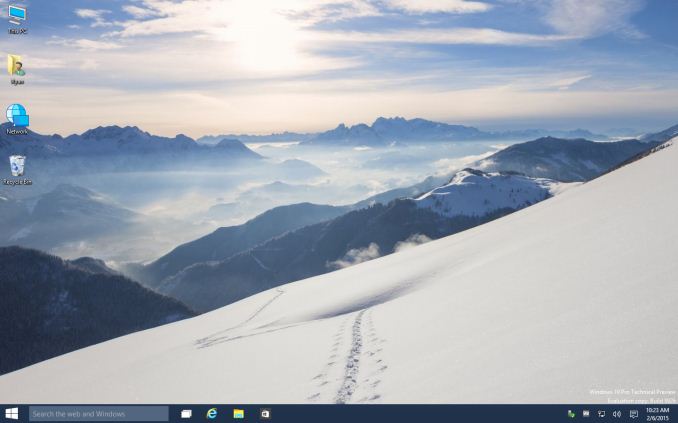
DirectX 12 was first announced at GDC 2014, where Microsoft unveiled the existence of the new API along with their planned goals, a brief demonstration of very early code, and limited technical details about how the API would work. Since then Microsoft has been hard at work on DirectX 12 as part of the larger Windows 10 development effort, culminating in the release of the latest Windows 10 Technical Preview, Build 9926, which is shipping with an early preview version of DirectX 12.
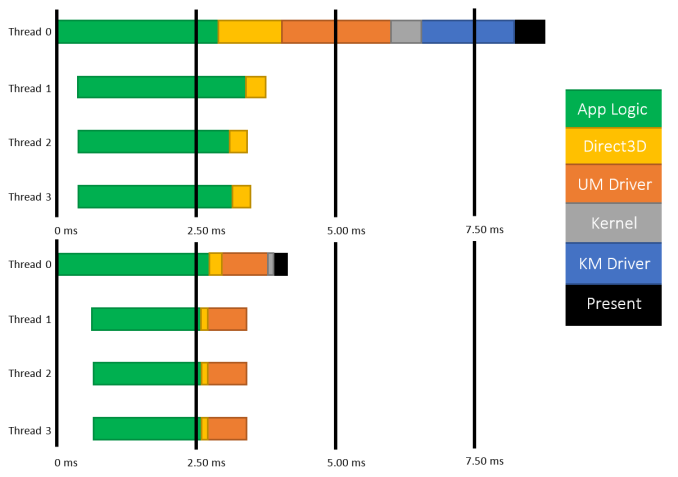
GDC 2014 - DirectX 12 Unveiled: 3DMark 2011 CPU Time: Direct3D 11 vs. Direct3D 12
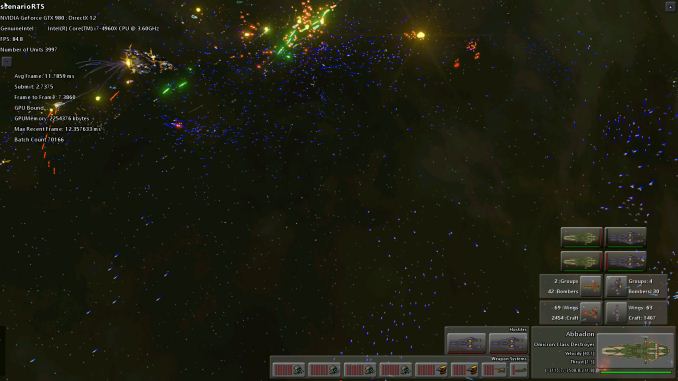
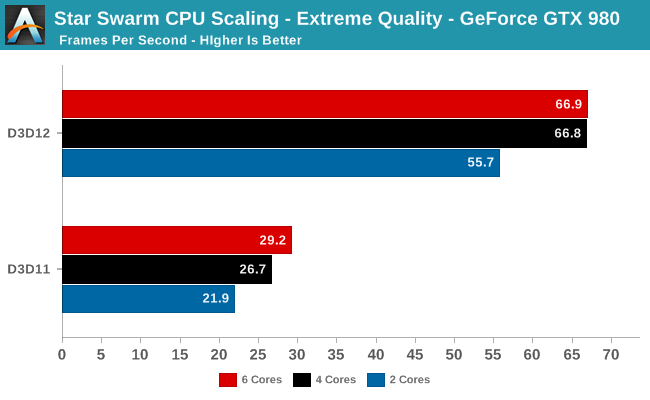
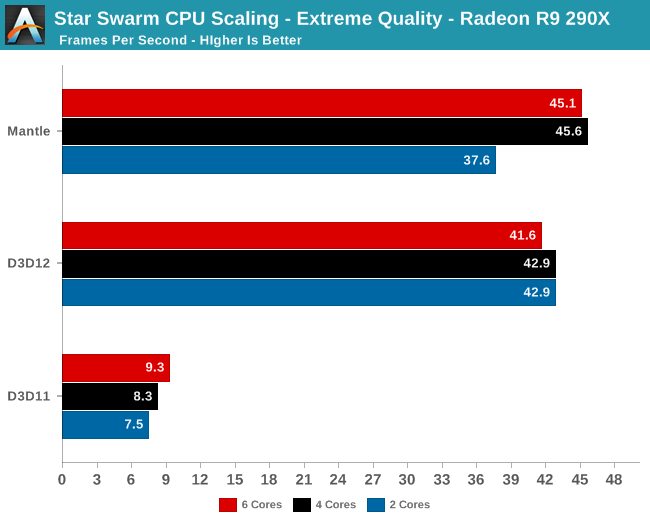
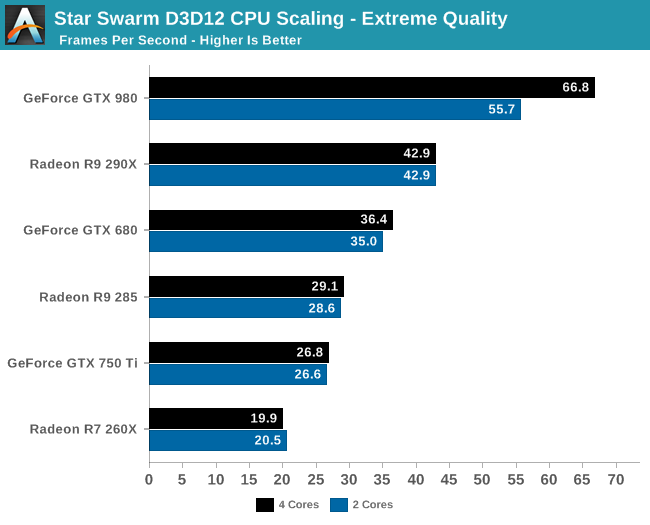
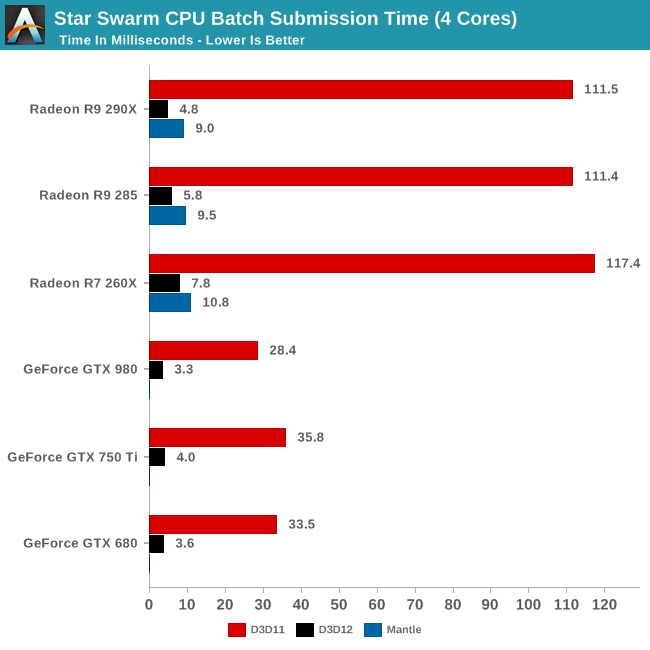
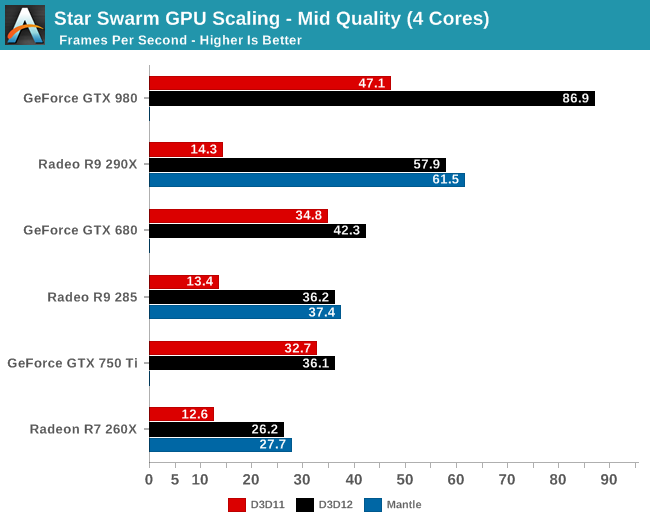
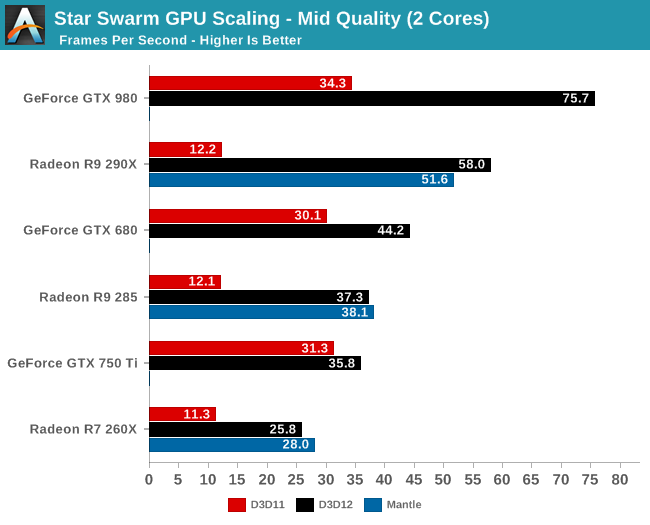
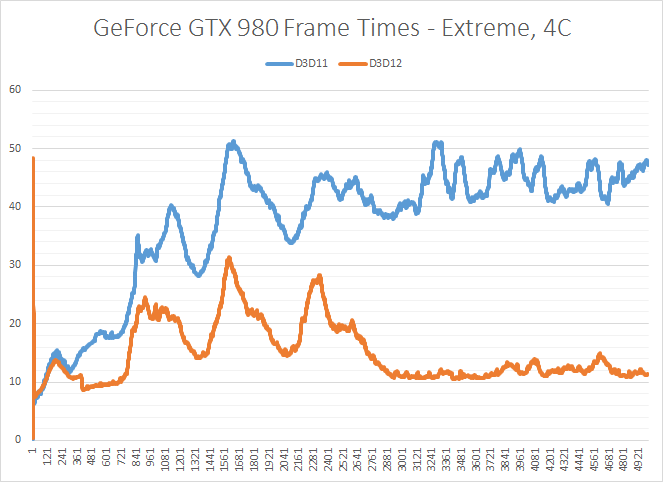
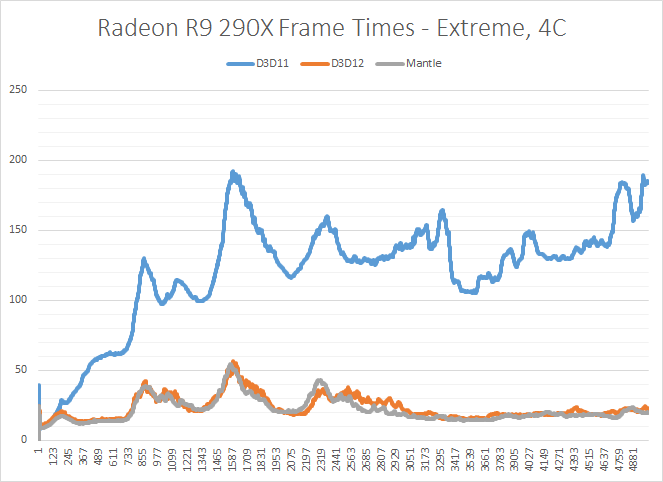
With the various pieces of Microsoft’s latest API finally coming together, today we will be taking our first look at the performance future of DirectX. The API is stabilizing, video card drivers are improving, and the first DirectX 12 application has been written; Microsoft and their partners are finally ready to show off DirectX 12. To that end, today we’ll looking at DirectX 12 through Oxide Games’ Star Swarm benchmark, our first DirectX 12 application and a true API efficiency torture test.
Does DirectX 12 bring the same kind of performance benefits we saw with Mantle? Can it resolve the CPU bottlenecking that DirectX 11 struggles with? How well does the concept of a low-level API work for a common API with disparate hardware? Let’s find out!
=======================================
The Current State of DirectX 12 & WDDM 2.0
Although DirectX 12 is up and running in the latest public release of Windows 10, it and many of its related components are still under development. Windows 10 itself is still feature-incomplete, so what we’re looking at here today doesn’t even qualify as beta software. As a result today’s preview should be taken as just that: an early preview. There are still bugs, and performance and compatibility is subject to change. But as of now everything is far enough along that we can finally get a reasonable look at what DirectX 12 is capable of.
From a technical perspective the DirectX 12 API is just one part of a bigger picture. Like Microsoft’s last couple of DirectX 11 minor version upgrades, DirectX 12 goes hand-in-hand with a new version of the Windows Display Driver Model, WDDM 2.0. In fact WDDM 2.0 is the biggest change to WDDM since the driver model was introduced in Windows Vista, and as a result DirectX 12 itself represents a very large overhaul of the Windows GPU ecosystem.
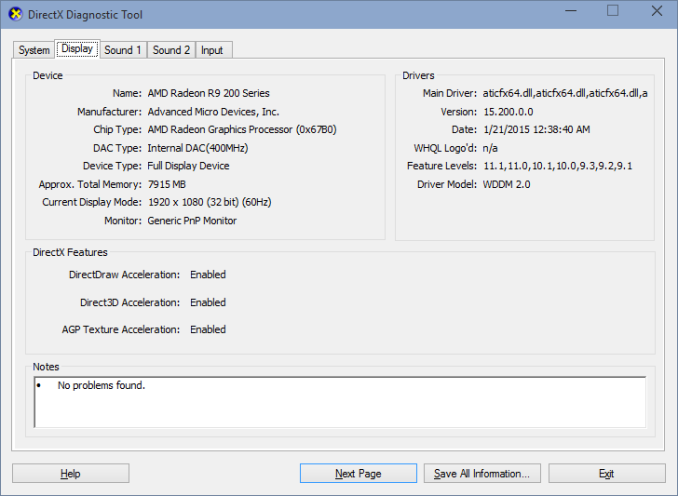
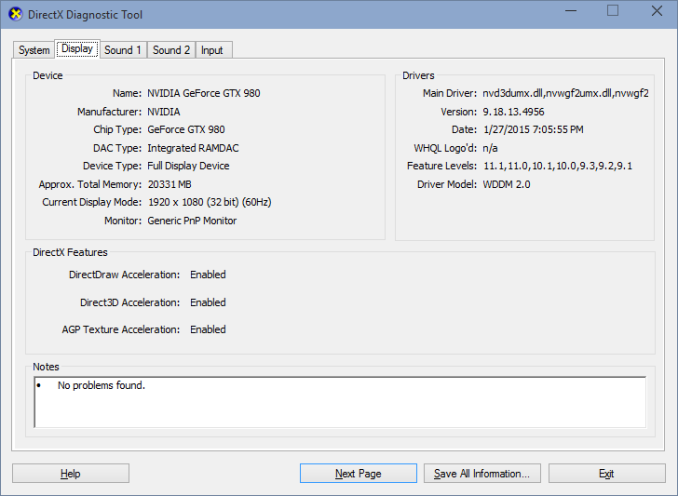
Top: Radeon R9 290X. Bottom: GeForce GTX 980
Microsoft has not released too many details on WDDM 2.0 so far – more information will be released around GDC 2015 – but WDDM 2.0 is based around enabling DirectX 12, adding the necessary features to the kernel and display drivers in order to support the API above it. Among the features tied to WDDM 2.0 are DX12’s explicit memory management and dynamic resource indexing, both of which wouldn’t have been nearly as performant under WDDM 1.3. WDDM 2.0 is also responsible for some of the baser CPU efficiency optimizations in DX12, such as changes to how memory residency is handled and how DX12 applications can more explicitly control residence.
The overhauling of WDDM for 2.0 means that graphics drivers are impacted as well as the OS, and like Microsoft, NVIDIA and AMD have been preparing for WDDM 2.0 with updated graphics drivers. These drivers are still a work in progress, and as a result not all hardware support is enabled and not all bugs have been worked out.

In short, among AMD and NVIDIA their latest products are up and running in WDDM 2.0, but not on all of their earlier products. In AMD’s case GCN 1.0 cards are supported under their WDDM 2.0 driver, but we are encountering texturing issues in Star Swarm that do not occur with GCN 1.1 and later. Meanwhile in NVIDIA’s case, as is common for NVIDIA beta drivers they only ship with support enabled for their newer GPUs – Kepler, Maxwell 1, and Maxwell 2 – with Fermi support disabled. Both AMD and NVIIDA have already committed to supporting DirectX 12 (and by extension WDDM 2.0) on GCN 1.0 and later and Fermi and later respectively, so while we can’t test these products today, they should be working by the time DirectX 12 ships.
Also absent for the moment is a definition for DirectX 12’s Feature Level 12_0 and DirectX 11’s 11_3. Separate from the low-level API itself, DirectX 12 and its high-level counterpart DirectX 11.3 will introduce new rendering features such as volume tiled resources and conservative rasterization. While all of the above listed video cards will support the DirectX 12 low-level API, only the very newest video cards will support FL 12_0, and consequently be fully DX12 compliant on both a feature and API basis. Like so many other aspects of DirectX 12, Microsoft is saving any discussion of feature levels for GDC, at which time we should find out what the final feature requirements will be and which (if any) current cards will fully support FL 12_0.
Finally, with Microsoft’s announcement of their Windows 10 plans last month, Microsoft is also finally clarifying their plans for the deployment of DirectX 12. Because DirectX 12 and WDDM 2.0 are tied at the hip, and by extension tied to Windows 10, DirectX 12 will only be available on Windows 10. Windows 8/8.1 and Windows 7 will not be receiving DirectX 12 support.

Backporting DirectX 12 to earlier OSes would require backporting WDDM 2.0 as well, which brings with it several issues due to the fact that WDDM 2.0 is a kernel component. Microsoft would either have to compromise on WDDM 2.0 features in order to make it work on these older kernels, or alternatively would have to more radically overhaul these kernels to accommodate the full WDDM 2.0 feature set, the latter of which is a significant engineering task and carries a significant risk of breaking earlier Windows installations. Microsoft has already tried this once before in backporting parts of Direct3D 11.1 and WDDM 1.2 to Windows 7, only to discover that even that smaller-scale project had compatibility problems. A backport of DirectX 12 would in turn be even more problematic.
The bright side of all of this is that with Microsoft’s plans to offer Windows 10 as a free upgrade for Windows 7/8/8.1 users, the issue is largely rendered moot. Though DirectX 12 isn’t being backported, Windows users will instead be able to jump forward for free, so unlike Windows 8 this will not require spending money on a new OS just to gain access to the latest version of DirectX. This in turn is consistent with Microsoft’s overall plans to bring all Windows users up to Windows 10 rather than letting the market get fragmented among different Windows versions (and risk repeating another XP), so the revelation that DirectX 12 will not get backported has largely been expected since Microsoft’s Windows 10 announcement.
Nguồn: Click vào đây
About a year and a half ago AMD kicked off the public half of a race to improve the state of graphics APIs. Dubbed "Mantle", AMD’s in-house API for their Radeon cards stripped away the abstraction and inefficiencies of traditional high-level APIs like DirectX 11 and OpenGL 4, and instead gave developers a means to access the GPU in a low-level, game console-like manner. The impetus: with a low-level API, engine developers could achieve better performance than with a high-level API, sometimes vastly exceeding what DirectX and OpenGL could offer.
While AMD was the first such company to publicly announce their low-level API, they were not the last. 2014 saw the announcement of APIs such as DirectX 12, OpenGL Next, and Apple’s Metal, all of which would implement similar ideas for similar performance reasons. It was a renaissance in the graphics API space after many years of slow progress, and one desperately needed to keep pace with the progress of both GPUs and CPUs.
In the PC graphics space we’ve already seen how early versions of Mantle perform, with Mantle offering some substantial boosts in performance, especially in CPU-bound scenarios. As awesome as Mantle is though, it is currently a de-facto proprietary AMD API, which means it can only be used with AMD GPUs; what about NVIDIA and Intel GPUs? For that we turn towards DirectX, Microsoft’s traditional cross-vendor API that will be making the same jump as Mantle, but using a common API for the benefit of every vendor in the Windows ecosystem.
DirectX 12 was first announced at GDC 2014, where Microsoft unveiled the existence of the new API along with their planned goals, a brief demonstration of very early code, and limited technical details about how the API would work. Since then Microsoft has been hard at work on DirectX 12 as part of the larger Windows 10 development effort, culminating in the release of the latest Windows 10 Technical Preview, Build 9926, which is shipping with an early preview version of DirectX 12.
GDC 2014 - DirectX 12 Unveiled: 3DMark 2011 CPU Time: Direct3D 11 vs. Direct3D 12
With the various pieces of Microsoft’s latest API finally coming together, today we will be taking our first look at the performance future of DirectX. The API is stabilizing, video card drivers are improving, and the first DirectX 12 application has been written; Microsoft and their partners are finally ready to show off DirectX 12. To that end, today we’ll looking at DirectX 12 through Oxide Games’ Star Swarm benchmark, our first DirectX 12 application and a true API efficiency torture test.
Does DirectX 12 bring the same kind of performance benefits we saw with Mantle? Can it resolve the CPU bottlenecking that DirectX 11 struggles with? How well does the concept of a low-level API work for a common API with disparate hardware? Let’s find out!
=======================================
The Current State of DirectX 12 & WDDM 2.0
Although DirectX 12 is up and running in the latest public release of Windows 10, it and many of its related components are still under development. Windows 10 itself is still feature-incomplete, so what we’re looking at here today doesn’t even qualify as beta software. As a result today’s preview should be taken as just that: an early preview. There are still bugs, and performance and compatibility is subject to change. But as of now everything is far enough along that we can finally get a reasonable look at what DirectX 12 is capable of.
From a technical perspective the DirectX 12 API is just one part of a bigger picture. Like Microsoft’s last couple of DirectX 11 minor version upgrades, DirectX 12 goes hand-in-hand with a new version of the Windows Display Driver Model, WDDM 2.0. In fact WDDM 2.0 is the biggest change to WDDM since the driver model was introduced in Windows Vista, and as a result DirectX 12 itself represents a very large overhaul of the Windows GPU ecosystem.
Top: Radeon R9 290X. Bottom: GeForce GTX 980
Microsoft has not released too many details on WDDM 2.0 so far – more information will be released around GDC 2015 – but WDDM 2.0 is based around enabling DirectX 12, adding the necessary features to the kernel and display drivers in order to support the API above it. Among the features tied to WDDM 2.0 are DX12’s explicit memory management and dynamic resource indexing, both of which wouldn’t have been nearly as performant under WDDM 1.3. WDDM 2.0 is also responsible for some of the baser CPU efficiency optimizations in DX12, such as changes to how memory residency is handled and how DX12 applications can more explicitly control residence.
The overhauling of WDDM for 2.0 means that graphics drivers are impacted as well as the OS, and like Microsoft, NVIDIA and AMD have been preparing for WDDM 2.0 with updated graphics drivers. These drivers are still a work in progress, and as a result not all hardware support is enabled and not all bugs have been worked out.
In short, among AMD and NVIDIA their latest products are up and running in WDDM 2.0, but not on all of their earlier products. In AMD’s case GCN 1.0 cards are supported under their WDDM 2.0 driver, but we are encountering texturing issues in Star Swarm that do not occur with GCN 1.1 and later. Meanwhile in NVIDIA’s case, as is common for NVIDIA beta drivers they only ship with support enabled for their newer GPUs – Kepler, Maxwell 1, and Maxwell 2 – with Fermi support disabled. Both AMD and NVIIDA have already committed to supporting DirectX 12 (and by extension WDDM 2.0) on GCN 1.0 and later and Fermi and later respectively, so while we can’t test these products today, they should be working by the time DirectX 12 ships.
Also absent for the moment is a definition for DirectX 12’s Feature Level 12_0 and DirectX 11’s 11_3. Separate from the low-level API itself, DirectX 12 and its high-level counterpart DirectX 11.3 will introduce new rendering features such as volume tiled resources and conservative rasterization. While all of the above listed video cards will support the DirectX 12 low-level API, only the very newest video cards will support FL 12_0, and consequently be fully DX12 compliant on both a feature and API basis. Like so many other aspects of DirectX 12, Microsoft is saving any discussion of feature levels for GDC, at which time we should find out what the final feature requirements will be and which (if any) current cards will fully support FL 12_0.
Finally, with Microsoft’s announcement of their Windows 10 plans last month, Microsoft is also finally clarifying their plans for the deployment of DirectX 12. Because DirectX 12 and WDDM 2.0 are tied at the hip, and by extension tied to Windows 10, DirectX 12 will only be available on Windows 10. Windows 8/8.1 and Windows 7 will not be receiving DirectX 12 support.
Backporting DirectX 12 to earlier OSes would require backporting WDDM 2.0 as well, which brings with it several issues due to the fact that WDDM 2.0 is a kernel component. Microsoft would either have to compromise on WDDM 2.0 features in order to make it work on these older kernels, or alternatively would have to more radically overhaul these kernels to accommodate the full WDDM 2.0 feature set, the latter of which is a significant engineering task and carries a significant risk of breaking earlier Windows installations. Microsoft has already tried this once before in backporting parts of Direct3D 11.1 and WDDM 1.2 to Windows 7, only to discover that even that smaller-scale project had compatibility problems. A backport of DirectX 12 would in turn be even more problematic.
The bright side of all of this is that with Microsoft’s plans to offer Windows 10 as a free upgrade for Windows 7/8/8.1 users, the issue is largely rendered moot. Though DirectX 12 isn’t being backported, Windows users will instead be able to jump forward for free, so unlike Windows 8 this will not require spending money on a new OS just to gain access to the latest version of DirectX. This in turn is consistent with Microsoft’s overall plans to bring all Windows users up to Windows 10 rather than letting the market get fragmented among different Windows versions (and risk repeating another XP), so the revelation that DirectX 12 will not get backported has largely been expected since Microsoft’s Windows 10 announcement.
Chỉnh sửa cuối:



 . Để xem có cao thủ nào chịu dịch không.


