-Tin mới từ web của Fallout 3 :
Fallout 3 những cái nhất từ sự đánh giá ...
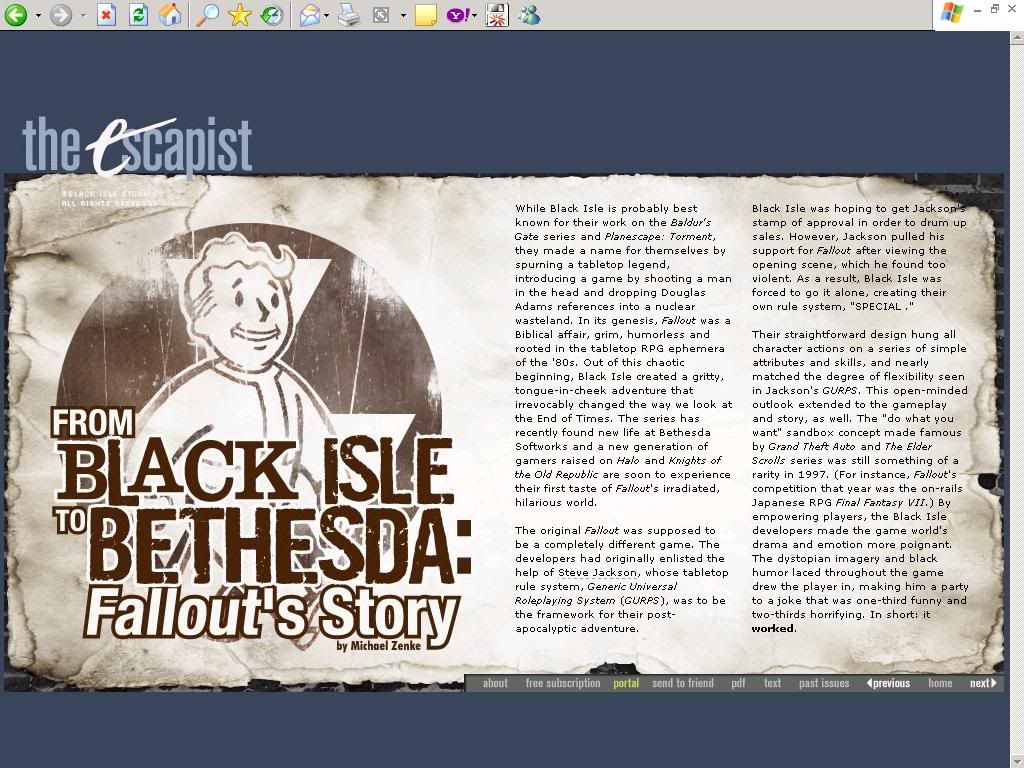
While Black Isle is probably best known for their work on the Baldur's Gate series and Planescape: Torment, they made a name for themselves by spurning a tabletop legend, introducing a game by shooting a man in the head and dropping Douglas Adams references into a nuclear wasteland. In its genesis, Fallout was a Biblical affair, grim, humorless and rooted in the tabletop RPG ephemera of the '80s. Out of this chaotic beginning, Black Isle created a gritty, tongue-in-cheek adventure that irrevocably changed the way we look at the End of Times. The series has recently found new life at Bethesda Softworks and a new generation of gamers raised on Halo and Knights of the Old Republic are soon to experience their first taste of Fallout's irradiated, hilarious world.
The original Fallout was supposed to be a completely different game. The developers had originally enlisted the help of Steve Jackson, whose tabletop rule system, Generic Universal Roleplaying System (GURPS), was to be the framework for their post-apocalyptic adventure.
Black Isle was hoping to get Jackson's stamp of approval in order to drum up sales. However, Jackson pulled his support for Fallout after viewing the opening scene, which he found too violent. As a result, Black Isle was forced to go it alone, creating their own rule system, "SPECIAL ."
Their straightforward design hung all character actions on a series of simple attributes and skills, and nearly matched the degree of flexibility seen in Jackson's GURPS. This open-minded outlook extended to the gameplay and story, as well. The "do what you want" sandbox concept made famous by Grand Theft Auto and The Elder Scrolls series was still something of a rarity in 1997. (For instance, Fallout's competition that year was the on-rails Japanese RPG Final Fantasy VII.) By empowering players, the Black Isle developers made the game world's drama and emotion more poignant. The dystopian imagery and black humor laced throughout the game drew the player in, making him a party to a joke that was one-third funny and two-thirds horrifying. In short: it worked.
Wasteland Revisted
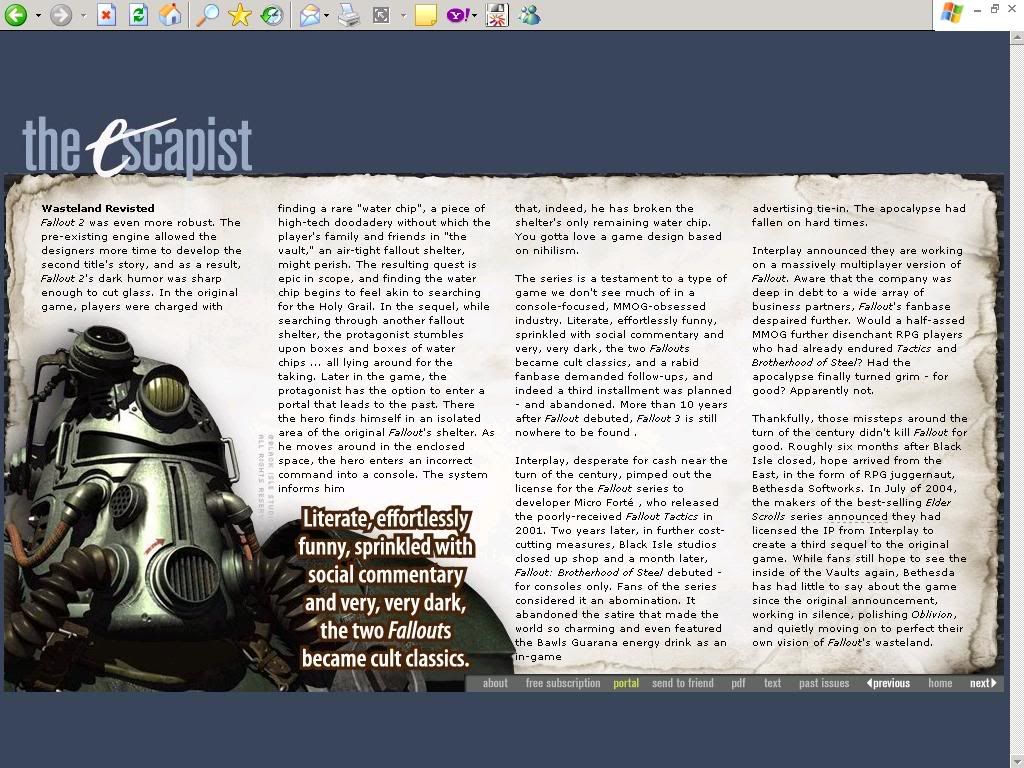
Fallout 2 was even more robust. The pre-existing engine allowed the designers more time to develop the second title's story, and as a result, Fallout 2's dark humor was sharp enough to cut glass. In the original game, players were charged with
finding a rare "water chip", a piece of high-tech doodadery without which the player's family and friends in "the vault," an air-tight fallout shelter, might perish. The resulting quest is epic in scope, and finding the water chip begins to feel akin to searching for the Holy Grail. In the sequel, while searching through another fallout shelter, the protagonist stumbles upon boxes and boxes of water chips ... all lying around for the taking. Later in the game, the protagonist has the option to enter a portal that leads to the past. There the hero finds himself in an isolated area of the original Fallout's shelter. As he moves around in the enclosed space, the hero enters an incorrect command into a console. The system informs him
that, indeed, he has broken the shelter's only remaining water chip. You gotta love a game design based on nihilism.
The series is a testament to a type of game we don't see much of in a console-focused, MMOG-obsessed industry. Literate, effortlessly funny, sprinkled with social commentary and very, very dark, the two Fallouts became cult classics, and a rabid fanbase demanded follow-ups, and indeed a third installment was planned - and abandoned. More than 10 years after Fallout debuted, Fallout 3 is still nowhere to be found .
Interplay, desperate for cash near the turn of the century, pimped out the license for the Fallout series to developer Micro Forté , who released the poorly-received Fallout Tactics in 2001. Two years later, in further cost-cutting measures, Black Isle studios closed up shop and a month later, Fallout: Brotherhood of Steel debuted - for consoles only. Fans of the series considered it an abomination. It abandoned the satire that made the world so charming and even featured the Bawls Guarana energy drink as an in-game
advertising tie-in. The apocalypse had fallen on hard times.
Interplay announced they are working on a massively multiplayer version of Fallout. Aware that the company was deep in debt to a wide array of business partners, Fallout's fanbase despaired further. Would a half-assed MMOG further disenchant RPG players who had already endured Tactics and Brotherhood of Steel? Had the apocalypse finally turned grim - for good? Apparently not.
Thankfully, those missteps around the turn of the century didn't kill Fallout for good. Roughly six months after Black Isle closed, hope arrived from the East, in the form of RPG juggernaut, Bethesda Softworks. In July of 2004, the makers of the best-selling Elder Scrolls series announced they had licensed the IP from Interplay to create a third sequel to the original game. While fans still hope to see the inside of the Vaults again, Bethesda has had little to say about the game since the original announcement, working in silence, polishing Oblivion, and quietly moving on to perfect their own vision of Fallout's wasteland.
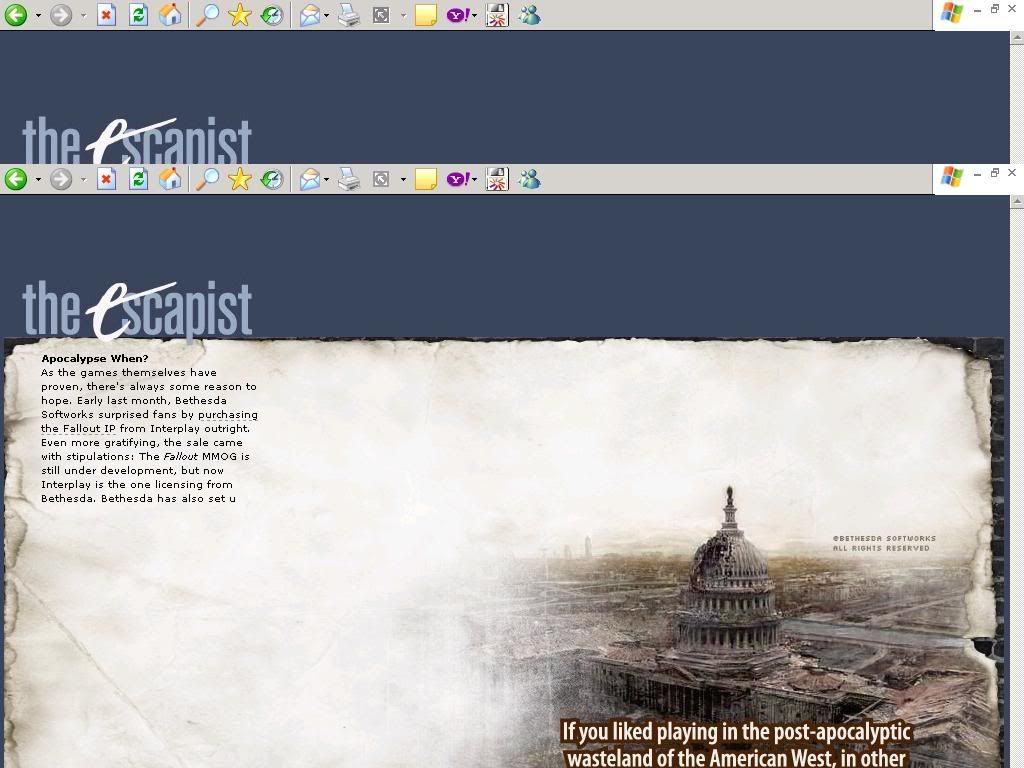
Apocalypse When?
As the games themselves have proven, there's always some reason to hope. Early last month, Bethesda Softworks surprised fans by purchasing the Fallout IP from Interplay outright. Even more gratifying, the sale came with stipulations: The Fallout MMOG is still under development, but now Interplay is the one licensing from Bethesda. Bethesda has also set u
Website chính thức của Fallout 3 có link sau :
http://fallout.bethsoft.com/
___________________________
-Tin mới từ web của Fallout 3 :
Fallout 3 những cái nhất từ sự đánh giá ... :hug:
While Black Isle is probably best known for their work on the Baldur's Gate series and Planescape: Torment, they made a name for themselves by spurning a tabletop legend, introducing a game by shooting a man in the head and dropping Douglas Adams references into a nuclear wasteland. In its genesis, Fallout was a Biblical affair, grim, humorless and rooted in the tabletop RPG ephemera of the '80s. Out of this chaotic beginning, Black Isle created a gritty, tongue-in-cheek adventure that irrevocably changed the way we look at the End of Times. The series has recently found new life at Bethesda Softworks and a new generation of gamers raised on Halo and Knights of the Old Republic are soon to experience their first taste of Fallout's irradiated, hilarious world.
The original Fallout was supposed to be a completely different game. The developers had originally enlisted the help of Steve Jackson, whose tabletop rule system, Generic Universal Roleplaying System (GURPS), was to be the framework for their post-apocalyptic adventure.
Black Isle was hoping to get Jackson's stamp of approval in order to drum up sales. However, Jackson pulled his support for Fallout after viewing the opening scene, which he found too violent. As a result, Black Isle was forced to go it alone, creating their own rule system, "SPECIAL ."
Their straightforward design hung all character actions on a series of simple attributes and skills, and nearly matched the degree of flexibility seen in Jackson's GURPS. This open-minded outlook extended to the gameplay and story, as well. The "do what you want" sandbox concept made famous by Grand Theft Auto and The Elder Scrolls series was still something of a rarity in 1997. (For instance, Fallout's competition that year was the on-rails Japanese RPG Final Fantasy VII.) By empowering players, the Black Isle developers made the game world's drama and emotion more poignant. The dystopian imagery and black humor laced throughout the game drew the player in, making him a party to a joke that was one-third funny and two-thirds horrifying. In short: it worked.
Wasteland Revisted
Fallout 2 was even more robust. The pre-existing engine allowed the designers more time to develop the second title's story, and as a result, Fallout 2's dark humor was sharp enough to cut glass. In the original game, players were charged with
finding a rare "water chip", a piece of high-tech doodadery without which the player's family and friends in "the vault," an air-tight fallout shelter, might perish. The resulting quest is epic in scope, and finding the water chip begins to feel akin to searching for the Holy Grail. In the sequel, while searching through another fallout shelter, the protagonist stumbles upon boxes and boxes of water chips ... all lying around for the taking. Later in the game, the protagonist has the option to enter a portal that leads to the past. There the hero finds himself in an isolated area of the original Fallout's shelter. As he moves around in the enclosed space, the hero enters an incorrect command into a console. The system informs him
that, indeed, he has broken the shelter's only remaining water chip. You gotta love a game design based on nihilism.
The series is a testament to a type of game we don't see much of in a console-focused, MMOG-obsessed industry. Literate, effortlessly funny, sprinkled with social commentary and very, very dark, the two Fallouts became cult classics, and a rabid fanbase demanded follow-ups, and indeed a third installment was planned - and abandoned. More than 10 years after Fallout debuted, Fallout 3 is still nowhere to be found .
Interplay, desperate for cash near the turn of the century, pimped out the license for the Fallout series to developer Micro Forté , who released the poorly-received Fallout Tactics in 2001. Two years later, in further cost-cutting measures, Black Isle studios closed up shop and a month later, Fallout: Brotherhood of Steel debuted - for consoles only. Fans of the series considered it an abomination. It abandoned the satire that made the world so charming and even featured the Bawls Guarana energy drink as an in-game
advertising tie-in. The apocalypse had fallen on hard times.
Interplay announced they are working on a massively multiplayer version of Fallout. Aware that the company was deep in debt to a wide array of business partners, Fallout's fanbase despaired further. Would a half-assed MMOG further disenchant RPG players who had already endured Tactics and Brotherhood of Steel? Had the apocalypse finally turned grim - for good? Apparently not.
Thankfully, those missteps around the turn of the century didn't kill Fallout for good. Roughly six months after Black Isle closed, hope arrived from the East, in the form of RPG juggernaut, Bethesda Softworks. In July of 2004, the makers of the best-selling Elder Scrolls series announced they had licensed the IP from Interplay to create a third sequel to the original game. While fans still hope to see the inside of the Vaults again, Bethesda has had little to say about the game since the original announcement, working in silence, polishing Oblivion, and quietly moving on to perfect their own vision of Fallout's wasteland.
Apocalypse When?
As the games themselves have proven, there's always some reason to hope. Early last month, Bethesda Softworks surprised fans by purchasing the Fallout IP from Interplay outright. Even more gratifying, the sale came with stipulations: The Fallout MMOG is still under development, but now Interplay is the one licensing from Bethesda. Bethesda has also set u
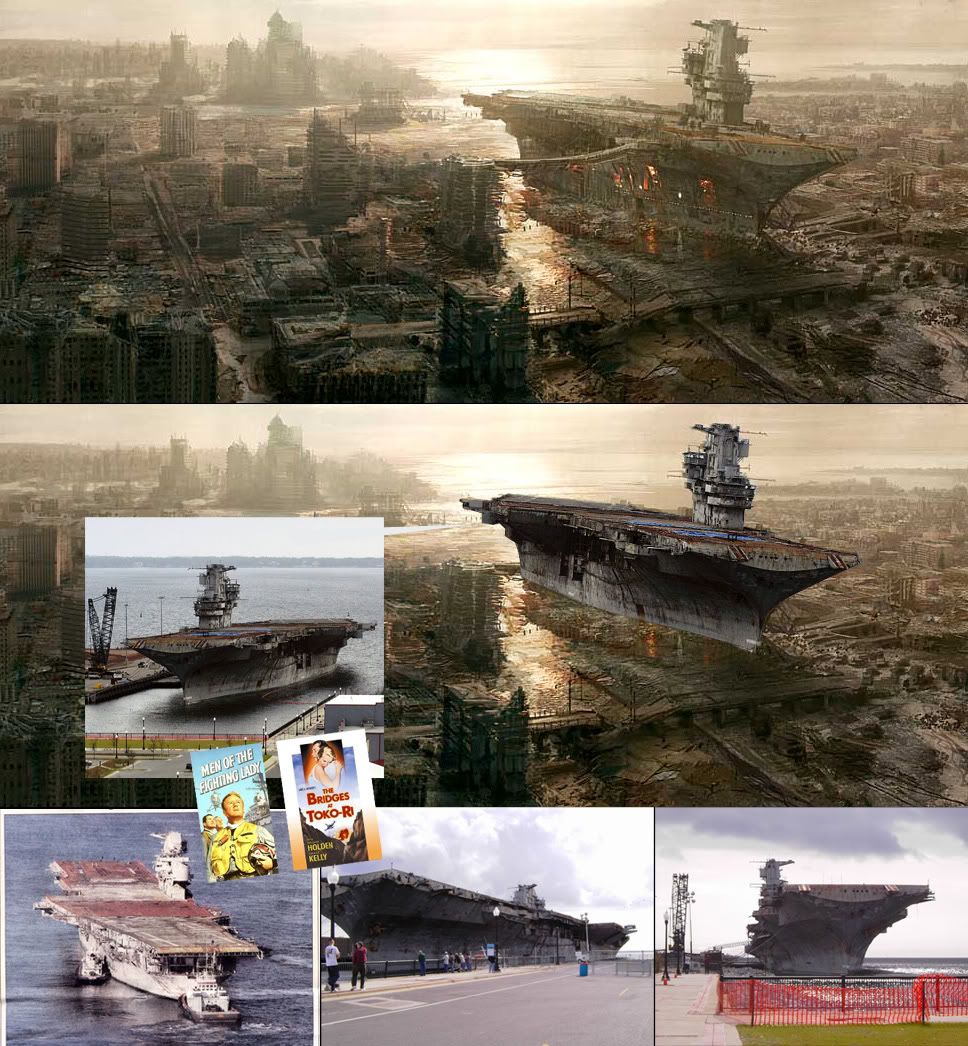
ĐIểm giống nhau đến bất ngờ trong Fallout 3 dành cho những ai cực kỳ tinh mắt :o
Website chính thức của Fallout 3 có link sau :
http://fallout.bethsoft.com/






 . Mà mấy báo VN thì toàn nhắm vào lớp trẻ với game online và .. audition
  . Cứ ra đi xem có ầm ĩ ko
  .
.![[Rest In Peace] Panzerklein](/data/avatars/m/245/245380.jpg?1410517359)

 . Đợi dài cả cổ...