"Three were given to the Elves: Immortal, wisest and fairest of all beings"
—Galadriel
The Three Rings of Celebrimbor, son of Curufin, were forged by Celebrimbor alone, and were never touched by Sauron. They were called Narya, the Ring of Fire, held first by Gil-galad, who later gave it to Círdan and then to Gandalf; Nenya, the Ring of Adamant, worn by Galadriel; and Vilya, the Ring of Air, borne first by Gil-galad, who later gave it to Elrond. They remained hidden, and the whereabouts of the three were not openly revealed until the end of the Third Age, after the One Ring was destroyed, and the Dark Lord Sauron was overthrown. Galadriel revealed her possession of one of the rings to Frodo while he was in Lothlórien. Later, while traveling down the River Anduin, Frodo spoke of it to Aragorn, who admonished him not to speak of it outside of Lórien.
Each of the Three Rings had special properties, but their powers were limited. During The Council of Elrond, Elrond stated that that neither he, nor Lórien, nor the Havens (the locations of the Three Elven Rings) had the power to withstand the might of Mordor.
Narya
Narya, the Ring of Fire. Formerly wielded by Gil-galad, then Gandalf.
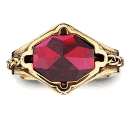
Narya, also named the Ring of Fire or Red Ring, is one of the Three Rings.
According to Unfinished Tales, at the start of the War of the Elves and Sauron, Celebrimbor gave Narya to Círdan, Lord of the Havens of Mithlond, who kept it after Gil-galad's death. In the Third Age Círdan, recognizing Gandalf's true nature as one of the Maiar from Valinor, gave him the ring to aid him in his labors. It is described as having the power to inspire others to resist tyranny, domination, and despair (in other words, evoking hope from others around the wielder), as well as giving resistance to the weariness of time:
"Take now this Ring," he said; "for thy labors and thy cares will be heavy, but in all it will support thee and defend thee from weariness. For this is the Ring of Fire, and herewith, maybe, thou shalt rekindle hearts to the valor of old in a world that grows chill" (Círdan the Shipwright to Gandalf).
Narya was worn by Gandalf at the Grey Havens. It was a gold ring adorned with a red ruby.
Nenya
Nenya, the Ring of Ice. Wielded by Lady Galadriel.
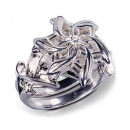
Nenya, also named as the Ring of Adamant, the White Ring and the Ring of Ice, is one of the Three Rings. The name is derived from the Quenya Nén meaning water.
Nenya is described as being made of mithril and set with a "white stone", presumably a diamond (this is never stated explicitly, although the usage of the word "adamant", an old synonym, is strongly suggestive). The ring is wielded by Galadriel of Lothlórien, and possessing radiance that matches that of the stars; while Frodo Baggins can see it by virtue of being a Ring-bearer, Samwise Gamgee tells Galadriel he only "saw a star through your fingers" (This appears in many editions as "finger" — which sounds more magical, since it suggests that her finger has somehow become transparent — but The Treason of Isengard, ch. 13, note 34, mentions it as an error.)
Nenya's power was preservation, protection, and possibly concealment from evil because it is stated about Lórien that "there is a secret power here that holds evil from the land". However, the fact that Orcs from Moria entered Lórien after the Fellowship of the Ring entered the forest and Lórien itself had suffered previous attacks from Sauron's Orcs sent from Dol Goldor suggests the power of the ring did not constitute military prowess. It was said that, protected as it was by Nenya, Lothlórien would not have fallen unless Sauron had personally come to attack it. Galadriel used these powers to create and sustain Lothlórien, but it also increased in her the longing for the Sea and her desire to return to the Undying Lands. After the destruction of the One Ring and the defeat of Sauron, its power faded along with the other Rings of Power. Galadriel bore Nenya on a ship from the Grey Havens into the West, accompanied by the other two Elven Rings and their bearers. With the Ring gone, the magic and beauty of Lórien also faded, along with the extraordinary mallorn trees that had lived for centuries, and it was gradually depopulated. By the time Arwen came there to die in FO 121 Lothlórien was deserted and in ruin.
Vilya
Vilya, the Ring of Air. Wielded by Lord Elrond.
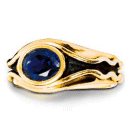
Vilya, the Ring of Air, Blue Ring, the Dominant Ring, or Ring of Sapphire is the greatest of the Three Rings.
When Sauron laid waste to Eregion, Vilya, along with Narya, was sent to the Elven-King Gil-galad far away in Lindon, where it was later given to Elrond, who bore it through the later years of the Second Age and all of the Third. As Gil-galad was the High King of the Noldor elves at the time of the rings' distribution it was thought that he was best fit to care for the most powerful of the three Elven rings. Like the other two Rings of the Elves, Vilya was jeweled: it contained a great blue stone set in a gold band, which contributed to its titles as the Ring of Sapphire and the Blue Ring. Vilya was also called the Ring of Air, signifying its preeminence even over the other Rings of the Elves, since Vilya was the mightiest of these three bands (as mentioned in the ending chapter in The Return of the King). The exact power of Vilya is not mentioned. It is reasonable to speculate that it also possesses the power to heal and to preserve, as it is mentioned in The Silmarillion that Celebrimbor had forged the Three for these purposes, rather than to enhance the strengths of each individual bearers as the Seven, Nine, and the lesser rings did. There is some speculation that the ring controlled minor elements, considering the event where Elrond had summoned a torrent of water as the Nazgûl attempted to invade Rivendell. The ring can possibly possess the power to see the future, because Elrond can see the future as well.
Upon Sauron's destruction, the power of Vilya faded and it was taken over the sea by Elrond at the end of the Third Age.



 mạng mềnh 1.6m/s thì khoảng 24-26h là xong... Nếu 60k/s thì lấy 1.6m = 1600k chia 60k = ~ 27. Vậy suy ra cắm 1 tháng thì down xong 77gb nếu mạng 60k/s... Làm gì đến mức bi quan ra đến phần 3 mà chưa down xong được...=] Dân cắm down mấy cái "độc hai" với hiếm thì cắm máy liên tục mấy tháng ròng là chuyện bình thường mà...=]]